 Dusty Garza
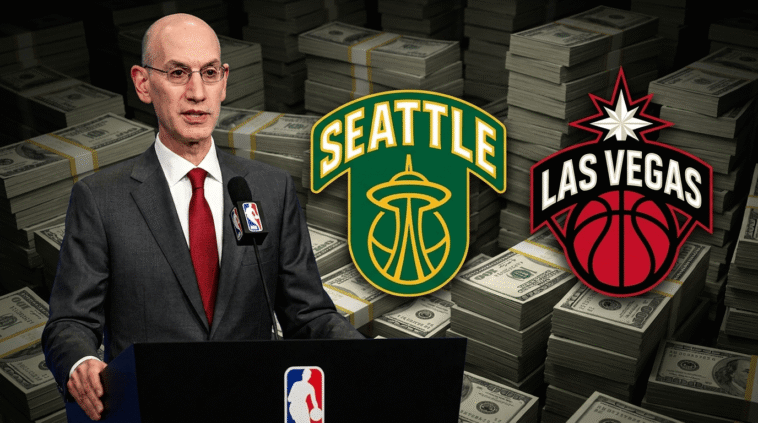
When the NBA first started tossing around the idea of a 32-team league, the rumor in executive circles was that a new franchise would cost somewhere around $4 billion to $6 billion. That baseline wasn’t pulled out of thin air; it was directly tied to the incredible $6.1 billion valuation the Boston Celtics fetched when they hit the market. At the time, that number felt like an absurd ceiling, a record-shattering watermark reserved for the league’s historic crown jewels.
Turns out, even that benchmark was aiming too low.
With momentum fully locking in for Las Vegas and Seattle to join the fold for the 2028-29 season, the bidding numbers reported by Shams Charania are blowing past expectations. Las Vegas groups are projected to push past $10 billion, while Seattle is tracking right around $7 billion.
Smashing the Old Blueprint
Why did those numbers skyrocket so fast? Simple math and extreme scarcity. There are only 30 slots in the NBA, making them some of the rarest and most coveted assets on earth. When private equity and deep-pocketed billionaires realized expansion slots might not open up again for decades, the bidding wars turned cutthroat. Vegas has essentially become the ultimate capital of sports entertainment, and the market responded accordingly.
While paying $10 billion to get into Vegas sounds wild, the real story is what happens to the existing 30 teams when those checks clear.
Expansion fees do not just sit in Adam Silver’s desk drawer. They get pooled together and split evenly across every single franchise in the league. If you do the math on a combined $17 billion haul from Vegas and Seattle, that means every single team in the NBA is looking at an unencumbered check worth roughly $566 million.
That kind of money changes the conversation for everyone, especially for small-market organizations.
Why Market Size Doesn’t Matter Anymore
Historically, being a small-market team meant sweating local media rights deals and pinching pennies to keep up with the spending power of coastal giants. But the modern NBA has completely rewritten that rulebook.
Look at a franchise like the San Antonio Spurs. Recent financial deep dives and league reports have highlighted San Antonio as a surprisingly massive revenue-generating machine. Thanks to a surging global brand, savvy operations, and generational talent like Victor Wembanyama, teams outside the traditional mega-markets are pulling in serious profit and ranking among the league’s healthiest businesses.
When you drop a casual half-billion-dollar expansion windfall into a small-market team’s bank vault, old boundaries vanish. It completely wipes out debt, funds state-of-the-art practice facilities, and guarantees a safety net that protects teams no matter what local television markets are doing.
The Ripple Effect: Salary Caps and Mounting CBA Tensions
While owners are popping champagne over eye-popping franchise valuations, this massive influx of capital is quietly fueling a new pressure cooker between the league and the players union. Expansion fees themselves are generally treated separately from Basketball Related Income, but adding two new teams fundamentally alters the ecosystem. More teams mean a larger talent drain, a different division of national media slices, and complex debates over how future revenues are distributed under the strict frameworks of the Collective Bargaining Agreement.
Players are already eyeing how these stratospheric team valuations translate into future player max contracts, luxury tax thresholds, and escrow protections. As team equity climbs toward the $10 billion mark while luxury tax aprons squeeze roster building, tensions behind closed doors at the bargaining table are only getting louder.
The Bottom Line
A rising tide lifts all boats, and a $10 billion price tag for an expansion team instantly raises the baseline floor for what every single franchise in the league is worth. Whether you play in Manhattan or South Texas, the NBA’s financial landscape has officially entered the stratosphere, and the battle over how to split the pie is only just beginning.