 Dusty Garza
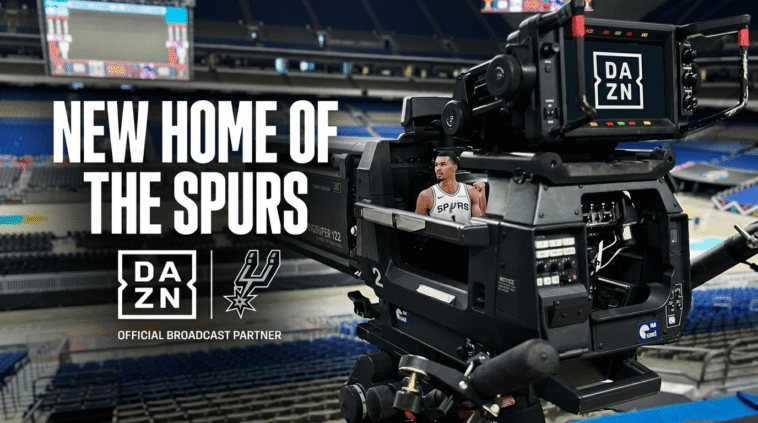
If you’ve spent the last few years rage-scrolling through your TV guide trying to find Spurs games on some dying regional sports network, this next sentence will feel surreal:
Starting with the 2026–27 season, the San Antonio Spurs are leaving the regional sports network world behind and moving their local broadcasts to DAZN, a direct‑to‑consumer streaming platform.
No more hunting for Bally. No more mystery carriage disputes. No more paying for a bloated cable bundle just to watch one team. But also: no more pretending this is as simple as “one app and done.”
This move is bigger than one team changing channels. It’s the local version of what’s happening all over sports: cable is losing its grip, streaming companies are circling, and the NBA is quietly building toward a world where it controls the whole thing itself.
Let’s unpack what this means if you’re a Spurs fan- and what it says about where the league is headed.
DAZN Is the New Home Base
At the most basic level, here’s the deal: DAZN will become the local streaming home for the Spurs in South, Central, and West Texas beginning in 2026–27.
If you’re in that footprint and you want to watch Spurs games that aren’t on national TV, DAZN is where you’ll be headed.
The package includes:
- Every non‑national regular season game
- All preseason games
- Spurs-produced shoulder programming—pregame shows, features, behind‑the‑scenes content, all living in one place
In other words, if you’re in San Antonio or Austin and you care about seeing Victor Wembanyama 60–70 nights a year, you’re going to have to learn how to spell “DAZN.”
What it’s not, though, is a forever move. This isn’t a 20‑year, “name the building after us” partnership. The NBA has been nudging teams toward short‑term, flexible “bridge deals” while it preps a centralized streaming product that could launch as soon as the 2027–28 season. The Spurs–DAZN arrangement fits right into that timeline.
Think of DAZN as the rebound—not the wedding ring.
The Price of Admission: About $1.70 to Watch Wemby Cook
The question every fan eventually gets to is simple: Alright, what’s this going to cost me?
DAZN’s Spurs package is set up to feel a lot lighter than a cable bill:
- You can go month to month at $19.99, if you just want to lock in for certain stretches.
- Or you can grab a Season Pass for $119.99, which covers roughly 65–70 non‑national games.
Do the math and you’re paying around $1.70–$1.85 per game to watch Wemby and friends. That’s roughly the cost of a bad gas station coffee to see him casually turn the paint into a personal no‑fly zone.
There’s also an “Ultimate” tier that tacks on a few extra bucks—about $5 more a month or $20 more for the season—and gives you alternate camera angles and tactical feeds. If you’re the type who rewatches possessions just to study help rotations, that’s your playground.
Compared to the old world where you shelled out $80+ per month for cable just to unlock one regional network somewhere in the 700s, $120 for a full year of local Spurs ball feels… almost sane.
Don’t Stream? The Spurs Didn’t Forget You
Here’s the underrated part of the move: the team didn’t abandon free TV.
Alongside the DAZN deal, the Spurs are keeping a 22‑game over‑the‑air package on free local broadcast television. The specific station will be announced, but the idea is clear: if you have a basic TV and a cheap digital antenna, you’ll still be able to watch a solid chunk of the season without paying for anything.
That free slate will likely feature:
- Big‑name opponents
- Key Wemby matchups
- Nights that matter to the broader community
So if you’re more “I check in when the games feel big” than “I watch every second of a February road trip,” you can probably live on a combination of those free broadcasts plus national games on ESPN, ABC, NBC/Peacock, and Amazon.
You won’t see everything. But you won’t be shut out, either.
The Trade You’re Making: Cable Tax vs. App Juggling
For years, the RSN model worked on one basic principle: everyone paid, whether they watched or not.
If you had cable in Spurs territory, you were helping fund local rights fees. Maybe you never watched a game in your life—you still chipped in $5–$9 every month for that sports channel baked into your bundle. Teams loved it. Networks loved it. Your wallet, not so much.
Then cord‑cutting hit. People started asking why they were paying so much for channels they never watched. They canceled in droves. The money that propped up those local TV deals dried up, and companies like Bally’s parent group crashed hard.
The Spurs and more than a dozen other teams suddenly found themselves without a stable TV home. DAZN swooped in as one of the few players willing to say: We’ll take the games. Let’s go direct to the fans.
So yes, the “cable tax” is gone. You’re no longer forced to buy 150 channels to watch Spurs–Grizzlies on a random Wednesday.
But you’re paying in a different way now: with fragmentation.
To see every single Spurs game in 2026–27, a diehard fan will need:
- DAZN for local games
- A digital antenna or basic broadcast setup for those 22 free OTA games
- Access to ESPN/ABC, NBC/Peacock, and Amazon Prime Video for national windows
In the cable era, the problem was “Why am I paying for stuff I don’t watch?”
In the streaming era, the problem is “Why are the things I do watch spread across five apps?”
Pick your poison.
Why DAZN, and Why Just for Now?
Around the league, teams have handled the RSN collapse in three main ways:
- A few, like the Suns and Jazz, went heavy on free broadcast, then backed it up with their own team‑run apps.
- Others scrambled into deals with different streaming partners and local broadcasters.
- A growing cluster—including the Cavs, Wolves, Pacers, and now the Spurs—linked up with DAZN.
DAZN’s pitch is simple: they already have a global sports streaming platform, they understand subscriptions, and they’re willing to move fast. For teams that suddenly found themselves without a TV partner, “ready on short notice” goes a long way.
But the real reason this isn’t a 10‑year, set‑in‑stone commitment is the bigger plan sitting in the background.
The NBA doesn’t just want to survive the RSN crash. It wants to own the next version of local TV.
League leadership has been open about its ambition: bring all local digital rights under one roof—likely by folding local in‑market games into an overhauled, smarter version of NBA League Pass. Instead of a maze of RSNs and side deals, you’d have one league‑run hub:
- In San Antonio, you open the NBA app and Spurs games live right there.
- In New York, it’s Knicks and Nets.
- Out‑of‑market fans still get the usual League Pass menu.
That kind of system takes time to build, legally and technically. Hence the guidance to teams: keep your deals short, your exits clean, and your options open.
The Spurs’ DAZN partnership does exactly that. It’s a bridge you can watch Wemby from.
What This Actually Means on Your Couch
Forget media jargon for a second. Picture your actual season.
If you’re a diehard, your setup in 2026–27 probably looks like this:
You subscribe to the DAZN Season Pass, mount a cheap antenna somewhere in the living room, and make sure at least one of your streaming services covers ESPN/ABC and NBC/Peacock, with Amazon running on the TV somewhere. It’s not as simple as “channel 35 every night,” but once you’ve set it up, it’s manageable—and you’re not paying for a bunch of channels you never touch.
If you’re a casual, you might skip DAZN entirely. You live on the 22 free OTA games and the national windows, watch highlights and social clips the next morning, and only dip into DAZN for a month or two if the Spurs suddenly look like they’re ready to crash the West hierarchy.
If you’re out of market, nothing major changes—this is still a League Pass story for you, with the usual blackout rules when you’re physically in Spurs territory.
In every case, the key difference is that you’re finally paying for Spurs games more or less directly, instead of funding a broken cable ecosystem and hoping it doesn’t crash mid‑possession.
The Big Picture: End of One Era, Start of Another
For Spurs fans, the headline is simple:
The Bally/RSN chapter is over. DAZN is up next.
For NBA fans more broadly, this is another step in a much bigger shift. The league is moving away from being something you stumble upon while flipping channels, and toward being something you intentionally subscribe to, on a platform that’s built for basketball first.
Is this DAZN phase perfect? No. You’re still going to have nights where you ask, “Wait, is this on DAZN, free TV, ESPN, or Amazon?”
But compared to trying to stream an RSN that was halfway to bankruptcy, locked behind a cable login, and blacked out on half the platforms you own, this is at least pointed in the right direction.
And if the NBA’s bigger plan hits on schedule, Spurs fans might look back on this stretch as the awkward transition phase between “Why am I paying for 200 channels?” and “I open one NBA app and everything just works.”
In the meantime, the math is straightforward:
About $1.70 a night to watch Wemby turn the court into a sci‑fi experiment, without having to sell your soul to a cable company.
As transitional eras go, that’s not a bad deal.