 Dusty Garza
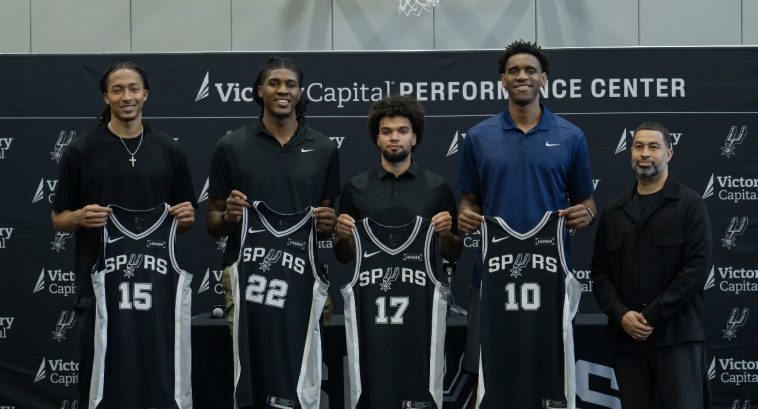
If you want to understand the structural direction of the San Antonio Spurs, forget the standard summaries floating around the internet. You just have to listen to the voices of the guys who just arrived in town.
San Antonio, fresh off thier electric postseason run that put the rest of the league on notice, front office architects did not hunt for flashy perimeter projects or empty statistical volume on draft night. Instead, the Spurs went out and collected a premium on raw power, interior resilience, and elite defensive processing speed.
The result is the assembly of a highly specialized unit designed to turn the city into a tactical fortress around Victor Wembanyama.

The Defensive Purist
The first thing that stands out about Maliq Brown is his sheer composure. Standing at six feet eight inches tall and carrying a lean, strong frame, he carries the physical weight and quiet confidence of a player who has already spent four intense years navigating the highest levels of collegiate basketball.
Born into an athletic family in Culpeper, Virginia, Brown won four consecutive state championships at the Blue Ridge School before starting his college journey. He established himself as an elite multi-positional switcher at Syracuse, where he earned ACC All-Defensive honors and led the conference in steals, before transferring to Duke. In his final year with the Blue Devils, he absolutely exploded, taking home the ACC Defensive Player of the Year award, the ACC Sixth Man of the Year award, and the prestigious Lefty Driesell Award as the National Defensive Player of the Year.
For Brown, the whirlwind of the last forty-eight hours is still sinking in, but he is already locking into the operational system.
“It has been a dream come true, definitely,” Brown says. “I am always looking forward in my life. Last night was a surreal moment just being around my family and friends back at home, and today just being around the arena and meeting new faces, it has been all good.”
He is a defensive purist who genuinely gets excited about charting floor geometry and disrupting passing lanes.
“Defense is always where I have hung my hat at,” he explains. “I have always paid attention to the Spurs culture and the way they play basketball. Knowing they are a very gritty team and just get all up and down with it on the defensive end, so I definitely can fit in with that.”
The true gravity of his new home hit him fully during an early morning meal when he looked up to see a couple of franchise pillars casually walking through the building.
“It was definitely a crazy experience,” Brown says. “We were just eating lunch and just seeing them, so it wasn’t something that I was aware that they were going to be here today. I feel like today is very fast-paced, but it was good just getting to meet them.”
He is already eager to absorb that knowledge, planning to maximize his time with the veterans.
“I want to learn as much as I can, just picking their brain, asking them different questions, not just about basketball, just being a human on and off the court,” he says. “I am just trying to figure out my role, just doing whatever I can to help the team as best and in many ways as possible.”
Watching the team’s playoff run from afar provided an instant spark.
“Watching the Spurs this past season definitely got me a good feeling and some chills in my body,” Brown admits.
The Backcourt Dog
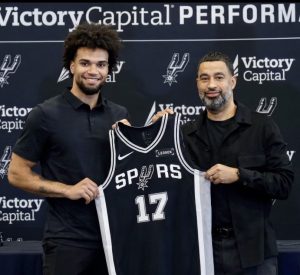
The perimeter engine of this new defensive front belongs to Ja’Kobi Gillespie, the electric playmaker out of the University of Tennessee whom the Spurs swiped in the second round at pick number forty-two. Born in Greeneville, Tennessee, where he dominated at Greeneville High School, Gillespie’s path to the league has been an incredible multi-stop masterclass in backcourt execution.
He began his college career at Belmont, earning MVC All-Freshman and All-Defensive honors while lighting up the scoreboard. He then moved to Maryland, where he took home Third-Team All-Big Ten honors and surpassed the 1,000 career point milestone. For his final season, he returned home to lead the Tennessee Volunteers, averaging an explosive 18.4 points and 5.4 assists per game while carrying the Vols to a fierce Elite Eight battle.
Gillespie looks completely relaxed, but there is a distinct edge to his posture—the unmistakable vibe of a guard who has spent his entire life playing with a massive chip on his shoulder.
“Backup plan? No, getting drafted is super exciting for me, my family, just my community,” Gillespie shares. “So, yeah, I’m super grateful for that and it has been fun meeting everybody.”
Standing at a compact six feet one inch and 181 pounds, he has always had to out-work and out-hit the opposition to survive the athletic scale of high-level hoops. When asked what he values most about his identity on the hardwood, his answer is immediate.
“Just how hard I play, how selfless I am on the court, just doing everything I can to help my team win,” he says.
Facing a constant physical size disadvantage completely prepared him to step up to the professional level.
“I think just having athleticism, being strong, and also just having heart, honestly,” Gillespie explains. “I’ve always been the smallest player, so I think just growing up like that kind of got me ready to play at a higher level. In the NBA, you just got to be a dog in a sense where you can’t let people pick on you. You got to be a little strong.”
Modeling his approach after his favorites, Kobe Bryant and Chris Paul, Gillespie balances high-volume shot creation with full-court defensive pressure. He views his job in San Antonio as bringing immediate stability to the rotation.
“Just like I said, impact and winning, just picking up the ball full court, shooting threes, whatever they need me to do,” he says.
He realized he could land here after a grueling pre-draft workout in San Antonio.
“I think it went good,” Gillespie reflects. “I don’t… I’m not speaking for them, but I think I played pretty well, I was playing super hard. That’s when I really figured out I could come here once I worked out for them.”
His main takeaway from moving around through different programs is an elevated perspective on preparation.
“I think just maturity,” Gillespie notes. “Going to a lot of different places, you’re meeting a lot of new people, learning a lot of new things, so you have to really lock in and be mature about everything going on. I think that’s the biggest thing I took from each step.”
To the fans, his message is clear: “To the Spurs fans, I’m just super grateful to be here. Top organization in the NBA, so, yeah, I’m just super honored and glad that I’m here and super excited.”
And when asked about setting up the primary offense on the floor, he laughs about the simplicity of launching lobs to Wembanyama: “Yeah, for sure. I mean, just throw it up there, that’s what it looks like.”
The Gritty Enforcer
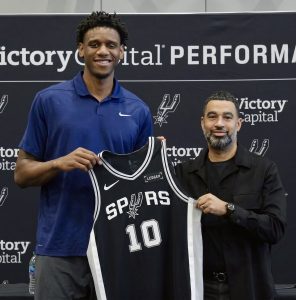
The physical interior enforcer of this class is Tarris Reed Jr., a massive six-foot-eleven, 265-pound mountain of a man from St. Louis, Missouri. Reed prepped at Chaminade College Prep before spending his senior high school season as an All-State selection at Link Academy. The son of Darlene and Tarris Reed, he spent his first two collegiate years starting for Michigan before transferring to UConn ahead of his junior year.
In Storrs, he put together a dominant, two-year championship-tested tenure under Dan Hurley, culminating in a senior campaign where he earned First Team All-BIG EAST honors, anchored the Huskies’ interior, and took home East Region Most Outstanding Player honors.
Now proudly sporting a sharp team shirt, he reflects on the transition.
“Some Husky blue, yeah sir, got to represent,” Reed chuckles, a nod to his championship roots. He has already heard from former teammate and top-tier Spurs building block Stephon Castle. “Yeah, he reached out,” Reed says. “Definitely going to talk to him more, but just knowing I got another fellow UConn Husky to play alongside with this year is going to be pretty special. Definitely going to talk about some cool, crazy, funny Hurley stories or just something that he went through that we both went through playing in that program.”
On trading into the first round to secure his frontline talent, Reed is profoundly grateful.
“Yeah, it’s a blessing, man,” he says. “Just to play in such a prestigious and just such an elite, legendary organization as the San Antonio Spurs, just to be here is a blessing, just ready to go.”
Reed takes immense pride in a style that is explicitly unapologetic.
“Ugly and gritty, I feel like that is what helped us win, man,” Reed shares. “I feel like especially going into this past year, my senior year at UConn, going all the way to the National Championship game, I really had to embrace that part of the game where you, like I said, you might not get a lot of credit for. So just my screening, my rebounding, my physicality, just being a force down low on both sides of the court. Sign me up, 10 out of 10 I’ll do it every time.”
He gives a hilarious inside look at a Dan Hurley practice session.
“Oh man, I don’t know, I feel like a lot of people have seen Coach Hurley go crazy in practice,” Reed laughs. “I mean, there would be times where he would like grab his head, be like ‘Tarris, Tarris!’ and then lay at half court on his back, and then start like kicking the balls during practice, yelling at you, but it’s all funny, you know, it’s all fun and games because he is a competitor and we’re all competitors. So just playing for a coach like Coach Hurley, I mean, he wants to coach at the highest level, he’s going to demand every single ounce, every potential, everything out of you, so you’re always just so appreciative and just grateful for a coach like that.”
Reed’s path to the Spurs required its own draft night drama in St. Louis, where a cellular dead zone left him completely in the dark.
“True, yeah man, so the whole story is I’m sitting down with my family, you know, I decided to have my draft party home in St. Louis and so I’m sitting down and I got a text from my guys, they text me like ‘yo, you going to San Antonio, blah blah blah’ and they said they’re going to trade with Denver,” Reed recounts.
“So I’m sitting down, I’m looking at my phone, I’m like alright, I didn’t get a call, like my phone bugging, my phone is tripping or what. So the pick is in, so I’m like damn, like that’s why I had my hand on my head, I was like ‘oh man, like I’m not… I’m probably not going to San Antonio, something might have messed up.’ So when they called my name, when I saw my name on the screen, it was just like this… that was like my pure, genuine, raw reaction right there. I was just like ‘oh shoot, I’m going to San Antonio.’ I was just excited and just blessed to be here.”
He understands the pain of losing a title, comparing his own deep collegiate run to the core group he is joining.
“After the National Championship? Yeah, that was probably one of the… that was probably the toughest moment of my life,” Reed admits.
“Especially working so hard for it, not knowing if you can really get there and then you’re actually there, and then when you get there you come up short. I mean, it’s just an undescribable feeling and it’s tough, it’s uncomfortable, so definitely sticks with me a little bit to this day, I’m not gonna lie. But yeah, I feel like just having a group of guys that really just went through that last year with San Antonio, and just… I feel like that’s going to be huge for us next year and like I said, that chip on the shoulder, you know, and wanting to really make things right.”
Off the floor, Reed is a stark contrast to his bruising play.
“Off the court? Yeah, I mean I’m definitely a bit of a contrast from how I play,” Reed shares. “I feel like the Lord just blessed me with this gift of just being able to communicate with people and reach people in a positive way, so I just praise Jesus for everything.”
He looks around at his fellow rookies, including his new frontcourt partner, with massive respect.
“Yeah, he got his head right on his shoulders, man,” Reed notes. “Just looking back at when I was a freshman, I was nowhere like that, man. Like he’s really mature, he got his head right. I mean, just him today, we’re… he was just… I’m watching him over there playing chess, we’re talking about anime, so just appreciative to be his teammate. I mean, he’s oozing with potential, so excited to see what the future holds for him. Yeah, I saw him playing on his phone.”
The Generational Savant
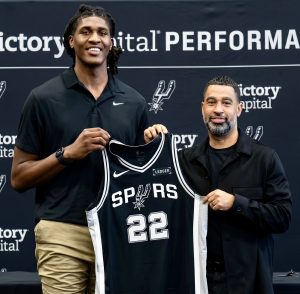
The final piece of the defensive vault belongs to Jayden Quaintance, the twentieth overall pick who enters the league with the reputation of a generational defensive savant. Born in Cleveland, Ohio, Quaintance moved through high school stops at Hillcrest Prep, Dream City Christian, and Word of God Christian Academy as a consensus five-star recruit and McDonald’s All-American. He reclassified to enter college early, meaning his massive six-foot-ten, 255-pound frame and wingspan are arriving in the NBA at just eighteen years old.
Basketball pedigree runs deep in his family; his father, Haminn Quaintance, was a star collegiate player at Jacksonville and Kent State. Jayden spent his freshman year at Arizona State, earning Big 12 All-Defensive and All-Freshman honors, averaging 9.4 points and 7.9 rebounds before a knee injury cut his season short. He transferred to Kentucky for his sophomore cycle, where further meniscus issues limited him to just four games before he declared for the draft.
Off the floor, his personality is completely focused and analytical, viewing his favorite hobby, chess, as a direct extension of his on-court logic.
“Off the court, I am an open book, more of a homebody,” Quaintance says smoothly. “I like to stay at home, read books, go on walks. On the board, my favorite chess piece is the knight, because there are a bunch of different tricks and tactics you can pull off with it- the tactics that you can pull off with it- so I’d probably say that’s my favorite piece.”
That exact appreciation for tactical flexibility is why he is so eager to join a switching defense that can shrink the floor and completely eliminate operating room in the paint.
“Defense wins games, that is half the game,” Quaintance says simply. “If you score more points than the other team, you win, and half of that is defense. I feel like we will be really able to shrink the floor and make it really hard to score in the paint.”
His relentless developmental drive comes directly from his family baseline.
“One of the lessons I learned the most is probably resilience,” Quaintance shares. “Him being a tougher player, having to fight through a bunch of adversity and different injuries of his own. And me having to grow up playing in a bunch of different situations, moving around a lot growing up, I feel like it taught me to be able to fight through situations, fight through different trials and tribulations I’ll have to fight. I have been carrying a basketball around everywhere since the sixth or seventh grade, keeping the mindset that when it is time to come back and play, I will be ready.”
The rookie is already deeply rooted in the history of his new franchise, even if his favorite historical player choice makes older fans feel a bit ancient.
“Probably Tim Duncan, I feel like he was my grandfather’s favorite player.”
He admits that his attempt to claim Duncan’s iconic number twenty-one jersey was met with a swift reality check from the front office.
“Yeah, they cut that down quickly, I am not gonna lie,” he chuckles. “As soon as I got drafted, they were like ‘here is a couple of number options that you’ll have.’ They killed that option pretty fast.”
He finishes by sending a direct message to the community that has embraced them all.
“Yeah, I mean, I’m excited to be here. I’m excited to be a part of the organization, I’m excited to see you guys. I mean, I’ve seen the watch parties during the finals, during the playoffs, so just having such a strong support system is going to be huge and I just love the friendly community and the closeness here.”
San Antonio is not building a roster for empty highlight reels. They have constructed a physical, defensive fortress from the baseline up, and the rest of the Western Conference is about to find out just how uncomfortable life in the paint is going to be for the next decade.