 Dusty Garza
The sky is allegedly falling in San Antonio. After dropping the first two games of the NBA Finals on their home floor, the Spurs look mathematically and physically overwhelmed. The New York Knicks, riding a historic 13-game playoff winning streak, have turned the series into a grueling street fight. Through 96 minutes, Mike Brown’s aggressive traps and the bruising interior tandem of Karl-Anthony Towns and Mitchell Robinson have successfully knocked the second-youngest Finals team in NBA history off its axis.
But before writing the eulogy for this Spurs season, it is mandatory to open the history books to the spring of 1977.
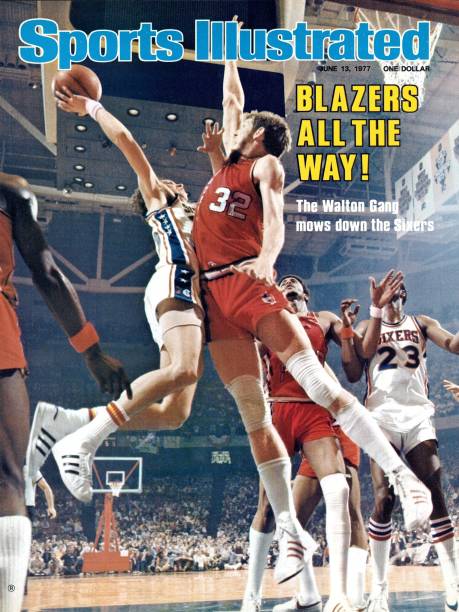
Almost fifty years ago, the only team younger than these Spurs to ever make it to the NBA Finals found themselves in the exact same predicament.
The 1977 Portland Trail Blazers, led by head coach Jack Ramsay, walked into the Finals and immediately went down 0-2 against a heavily favored, physically imposing and star filled Philadelphia 76ers squad.
What followed was one of the greatest tactical and psychological turnarounds in basketball history.
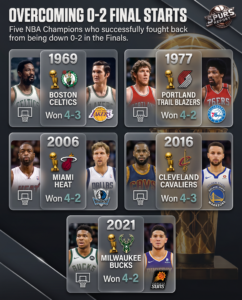
The Blazers did not just win Game 3; they swept the next four games to capture the title. That legendary Blazers squad remains one of only five teams in NBA history to ever overcome a 2-0 deficit to win the championship. For the 2026 San Antonio Spurs, the ’77 Blazers are not just a fun trivia answer. They are the exact blueprint for salvation.
Here is how San Antonio can channel the spirit of Portland, deploy a radical lineup adjustment, and completely flip the script on the New York Knicks as the series shifts to Madison Square Garden in NYC for Games 3 and 4.
Step 1: Neutralize the Bully
The 1977 Finals turned on a dime late in Game 2. As the Sixers were blowing the Blazers out, a massive brawl erupted. Philadelphia’s enforcer Darryl Dawkins threw a wild punch, and Portland’s Maurice Lucas immediately charged in to meet him at center court. Both were ejected, but the psychological damage was done: the young Blazers proved they would not be physically intimidated.
The modern NBA does not tolerate bare-knuckle brawls, but the underlying principle remains paramount. The Knicks have bullied the Spurs, using Josh Hart and Jalen Brunson to dictate the physical terms of engagement.
San Antonio has to draw a line in the sand. Shifting to the Garden in NYC for Games 3 and 4, the Spurs must meet New York’s point-of-attack pressure with matching ferocity. If rookies Stephon Castle and Dylan Harper can absorb the contact without coughing up the basketball in hostile territory, the structural integrity of the Knicks’ intimidation game completely collapses.
Step 2: The Three-Guard Antidote
The 76ers of 1977 relied on the sheer isolation brilliance of Julius Erving. Jack Ramsay countered by installing a relentless motion offense that quite literally exhausted Philadelphia’s defenders.
For the Spurs to replicate this, they have to permanently unleash the statistical anomaly that flashed at the end of Game 2, which is playing De’Aaron Fox, Stephon Castle, and Dylan Harper at the exact same time.
Over the first two games, this three-guard lineup has only shared the floor for roughly 11 minutes. In that tiny window, they posted an earth-shattering 143.5 Offensive Rating.
Mike Brown’s defense thrives on overloading the strong side and throwing hard traps at a primary ball-handler. When the Spurs play a traditional lineup, the Knicks easily rotate and recover. But when Fox, Castle, and Harper share the floor, the traps become suicidal. If New York blitzes Fox, he simply outlets the ball to Harper or Castle, both of whom possess the elite downhill vision to instantly fracture the shifting defense.
Step 3: The Fifth Man Dilemma
Deploying a three-guard lineup alongside Victor Wembanyama leaves one burning question for the coaching staff: who fills the fifth spot? The choice will dictate whether San Antonio matches New York’s brute force or leans entirely into the mathematical chaos of modern spacing.
The Counter-Punch: Bringing in a Second Big?
If the Spurs want to directly insulate Wembanyama from the physical tax of battling Karl-Anthony Towns and Mitchell Robinson alone, they could insert a traditional second big. This approach gives Wembanyama a frontline partner to absorb hard contact, anchor the paint, and fight for defensive rebounds. The risk, however, is that adding another traditional big cloaks the middle, potentially compromising the pristine spacing and driving lanes that Fox, Harper, and Castle need to collapse Mike Brown’s perimeter traps.
Comeback Blueprint: The Devin Vassell Option
During the ferocious fourth-quarter comeback in Game 2, the Spurs opted for a different answer by keeping Devin Vassell on the floor as the fifth player. It paid off massively. Vassell did not just provide a lethal perimeter threat to prevent the Knicks from sagging into the paint; he fought well above his weight class on the glass, tracking down crucial long rebounds off missed New York jumpers.
Retaining Vassell as the fifth piece creates a hyper-fluid, five-out offensive shell. Because Vassell can run, shoot, and rebound on the perimeter, his presence forces the Knicks’ heavy wings away from the basket. This leaves the paint completely open for the three guards to penetrate or for Wembanyama to operate without a secondary defender immediately helping down.
Step 4: Reimagining the “Bill Walton Hub”
The final piece of the 1977 puzzle was Bill Walton. Instead of having him battle in the crowded low-post, Ramsay moved Walton to the elbows, using him as a high-post passing hub. Walton’s gravity pulled Philadelphia’s big men away from the rim, opening up massive cutting lanes for Portland’s guards.
This is exactly what the Spurs must do with Victor Wembanyama.
In Game 2, Wembanyama was limited to a staggering four field goal attempts in the first half because the Knicks’ bigs pushed him out of the paint. The three-guard lineup, especially when optimized with Vassell’s spacing, fixes this. With Fox, Castle, and Harper endlessly pressuring the rim, the Knicks’ frontcourt will be forced to step up and stop the ball.
Instead of leaving Wembanyama stranded in a static post-up, the Spurs can use him as the ultimate trailing spacer and high-post hub. As the guards penetrate, Wembanyama can slip into open pick-and-pop space or execute devastating vertical cuts when Towns and Robinson are caught out of position.
The No Guts No Glory Gamble
There is a catch, of course. Playing small-ball for extended stretches bleeds a heavy 133.1 Defensive Rating. It requires Castle to take on the massive burden of guarding Jalen Brunson directly, and it demands that perimeter players like Vassell repeat their heroic rebounding efforts to prevent New York from feasting on second-chance opportunities in the Garden.
But down 0-2, the time for playing it safe has expired. The 1977 Trail Blazers proved that a young team’s greatest asset is its ability to out-pace and out-think an older, heavier opponent. By committing to the three-guard lineup, solving the fifth-man equation, and weaponizing Wembanyama in space, the Spurs can force the Knicks into a style of basketball they simply cannot sustain.
The blueprint is there. Now, it is time to execute.