 Dusty Garza
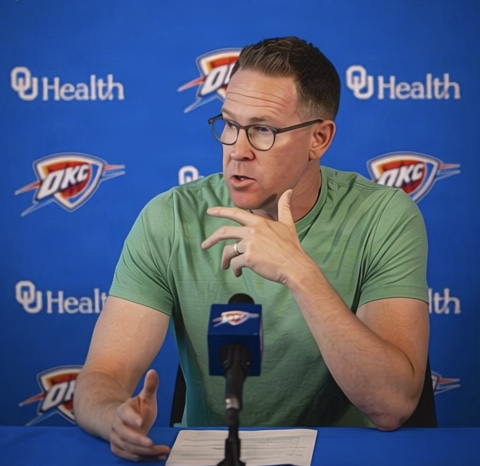
OKLAHOMA CITY — The immediate reaction to seeing Jalen Williams stretchered off the Paycom Center floor late in Sunday’s fourth quarter against the LA Clippers was shock. The second reaction across league circles was familiar muscle memory: Sam Presti will fix this.
With dozens of draft picks stockpiled in the Thunder vault, the conventional NBA logic suggests that if any franchise can withstand a devastating blow to a core co-star, it is Oklahoma City. If Williams faces an extended absence, Presti should theoretically be able to dial up a lottery team, push three first-rounders across the table, and bring back a high-caliber offensive creator to keep OKC’s title pursuit alive.
Except the modern Collective Bargaining Agreement does not care about your draft picks. It cares about payroll thresholds.
And for all of Presti’s asset wealth, the new second apron rules have turned the Thunder’s war chest into a gold reserve locked inside a vault with no door.
The $6.9 Million Wall
To understand Oklahoma City’s predicament, look at the bottom line of their cap sheet rather than their draft board.
The Thunder are currently operating above the first apron and sit just $6.9 million below the second apron line ($221,686,000).
Presti has spent the last year meticulously engineering this roster to stay underneath that second apron—most notably shedding long-term money in the Luguentz Dort deal to create cap breathing room and stash trade exceptions. That restraint was deliberate: crossing the second apron triggers a punitive, roster-freezing straitjacket. Teams past that line lose salary aggregation in trades, cannot send cash, cannot use pre-existing trade exceptions, cannot take back more salary than they send out, and eventually see their future first-round picks frozen and pushed to the end of the round.
Crossing that threshold is an institutional non-starter for Oklahoma City. That means $6.9 million is Presti’s hard ceiling for any net salary increase.
The Salary-Matching Nightmare
If Oklahoma City wants to acquire an established perimeter creator making $20 million to $30 million to bridge the gap left by Williams, how do they get there legally under CBA guidelines?
Because OKC is already an over-the-cap, tax-paying outfit above the first apron, they cannot absorb high salaries into open space. They are bound by restrictive matching rules:
1. They cannot take back a dollar more than they send out. Under first-apron mechanics, teams cannot take back 125% of outgoing salary; they must essentially match dollar-for-dollar.
2. They cannot easily bundle without gutting rotation depth. To match a $25 million salary, OKC would have to package multiple rotation pieces—names like Alex Caruso ($19.5M), Jaylin Williams ($7.7M), Cason Wallace ($7.4M), or Kenrich Williams ($5.0M). Trading away two or three high-utility rotation players to land one creator defeats the entire purpose of depth preservation.
3. Their Traded Player Exceptions (TPEs) can’t combine. OKC holds sizable trade exceptions—including a $17.7M TPE generated from the Dort move. But under CBA rules, TPEs cannot be combined with player salaries or other exceptions to acquire an expensive star. A $17.7M exception can only absorb a player making $17.7M or less. And even then, absorbing a $15M player into an exception would immediately push OKC over the second apron, which they cannot do without sending out matching money elsewhere.
A devastating scene in Oklahoma City tonight. Thunder star Jalen Williams had to be stretchered off late in the 4th quarter against the Clippers after suffering a severe lower left leg injury on an awkward landing. https://t.co/1EGBPSqi3R
— SpursRΞPORTΞR (@SpursReporter) October 26, 2026
Why a Disabled Player Exception Won’t Bail Them Out
If Williams’ injury is unfortunately confirmed by league doctors to be season-ending, OKC will likely be granted a Disabled Player Exception (DPE).
Fans often mistake the DPE for cap relief. It isn’t.
A DPE is purely a roster mechanism allowing a team to sign a free agent or claim a player on an expiring contract for 50% of the injured player’s salary (or the non-taxpayer mid-level exception, whichever is lower). Crucially:
A DPE provides zero cap or tax forgiveness.
Every dollar spent via a DPE adds directly to the team’s team salary and luxury tax bill.
Spending the full exception would immediately vault Oklahoma City deep into second-apron territory.
In short, the exception is virtually unusable for a team hovering $6.9M below the second apron unless they dump equivalent salary in a separate deal first.
The Realistic Path Forward for Presti
Sam Presti will work the phones, but Thunder fans should temper expectations of a blockbuster swing. The mechanics of the 2026-27 cap environment dictate a much narrower playbook:
The Sub-$7M Target: Finding a functional rotational ball-handler or wing shooter on a cheap, rookie-scale deal or minimum deal where OKC can absorb the contract straight into their remaining second-apron cushion without sending rotation talent out.
The Salary Dump Swap: Finding a rebuilding squad willing to take on draft capital to absorb Kenrich Williams’ expiring deal while sending back an under-the-radar wing with equivalent money.
Internal Elevation: Trusting Cason Wallace, Ajay Mitchell, and Nikola Topić to shoulder primary and secondary creation duties next to Shai Gilgeous-Alexander.
Draft picks can buy you talent, but they cannot buy you exemption from the CBA ledger. Until the full medical prognosis on J-Dub arrives, Oklahoma City’s biggest obstacle to staying afloat in the West isn’t finding a willing trade partner—it’s navigating the financial straitjacket of the second apron.