 Dusty Garza
The axiom that data and talent decide postseason basketball is absolute- until the league releases the morning official assignments.
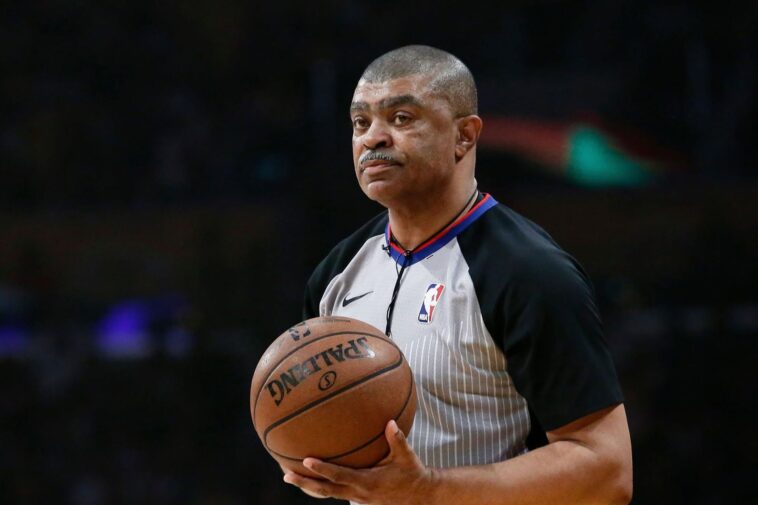
As the Western Conference Finals return to Oklahoma City for a pivotal, deadlock-breaking Game 5 between the San Antonio Spurs and the Thunder, the strategic chess match between Mitch Johnson and Mark Daigneault has been handed a volatile new variable. The NBA has designated 30-year veteran Tony Brothers as Crew Chief, flanked by James Capers and Sean Wright.
Historically, the winner of a tied Game 5 secures the series roughly 82% of the time. Yet, before a single shot has been contested at the Paycom Center, the narrative has shifted from roster matchups to the idiosyncrasies of the whistle. When Brothers takes the floor for a swing game, fanbase anxiety spikes on both sides, and for good reason: his historical metrics and strict game management style alter how players are permitted to compete.
The Metrics: Home Court Insulated by the Numbers
Every official possesses distinct statistical footprints. Brothers, one of the league’s most tenured active referees, has earned a reputation for maintaining a high baseline of home-court stability.
The 63% Anchor: Across his extensive career as a lead official, home teams secure victories at a clip exceeding 63%. In a hostile, high-decibel road environment, that macroeconomic trend mathematically favors the top-seeded Thunder.
The Pace and Premium on Efficiency: During the current season, Brothers’ assignments have strongly leaned toward high-scoring outcomes, going 44-27 against the Over with a robust average total game score of 230.1 points. Crucially, this does not indicate a loose whistle; rather, it reflects a strict enforcement of physical recovery defense. Brothers frequently penalizes defenders who recover late out of position, which naturally rewards high-volume driving teams.
For the young Spurs perimeter defense, this is a glaring red flag. If Brothers establishes a tight, zero-tolerance zone on touch fouls, Oklahoma City’s driving engine—anchored by Shai Gilgeous-Alexander—will actively exploit the whistle to isolate defenders and manufacture trips to the charity stripe.
The Tactical Tussle: Perimeter Grips vs. The Wembanyama Rim Effect
Through the first four games of this series, the overarching narrative on film has been physical, perimeter-denial defense. The officiating crews have largely permitted a playoff-level intensity, allowing defenders to use their hands to disrupt driving lanes. This physical leeway on the outside has played directly into San Antonio’s hands, funneling ball-handlers toward the elite, long-armed rim protection of Victor Wembanyama.
Brothers’ presence threatens to fundamentally alter that defensive ecosystem.
If the perimeter whistle is called strictly tonight, OKC’s driving guards will challenge the paint with high-frequency aggression, hunting for contact rather than trying to finish over Wembanyama’s historic wingspan. If Wembanyama picks up two early, marginal fouls in the first quarter trying to assist on compromised perimeter drives, San Antonio’s entire defensive infrastructure collapses.
Conversely, the Thunder must play with clinical discipline. Brothers is notorious for penalizing exaggerated contact; if Oklahoma City begins hunting fouls rather than executing their standard drive-and-kick sequences, they risk stall-outs and empty possessions.
Emotional Management and the Short Fuse
By pairing Brothers (216 career playoff games) with James Capers (204) and Sean Wright (104), the NBA has deployed an authoritative, heavyweight crew boasting over 520 games of collective postseason experience. The league’s intent is clear: ensure an emotionally charged, high-stakes swing game does not spiral out of control.
However, the byproduct of an authoritative crew is an exceptionally short fuse regarding player dissent. Brothers is renowned for having an iron-fisted policy toward player demonstration or verbal tracking.
For Coach Johnson’s squad, emotional composure is paramount. If a rookie like Stephon Castle or the bench becomes visibly frustrated by a non-call, Brothers will not hesitate to issue a technical foul. In a game projected to have a razor-thin margin, a single point surrendered to an emotional outburst can dictate the outcome of a season.
The Verdict
Game 5 will not be won simply by who executes their half-court sets more effectively; it will be won by the team that decodes and adapts to tonight’s whistle first- especially in such a defense oriented battle.
The Spurs’ coaching staff has no doubt prepared their roster for an entirely different officiating rhythm than what they experienced back home. Watch the opening six minutes closely: the speed of the first coach’s challenge and the location of the early fouls will reveal the exact framework of the game. The script for Game 5 is being written in real-time, and Tony Brothers holds the pen.